Taking notes & good science
January 1, 2023You can’t have good science without taking notes unless you remember what you had for lunch 58 days ago. Science is about forming consensus and being able to replicate experiments. How can you repeat what you don’t remember? Have I convinced you? No? Then leave. Don’t read the rest. Have you convinced yourself now? I hope so… grrrrrrrrr
Googling brings up some good things about note-taking in general:
- Cornell Method: Divide your notepaper into a main notetaking area, a cue column, and a summary section.
- Mapping: This visual way of note-taking involves creating a diagram or mind map of related concepts and ideas.
- Charting: Charting involves creating tables, graphs, or charts to organize and summarize information.
- Outlining: Outlining involves creating an organized information hierarchy using headings and subheadings.
- Sketchnoting: Sketchnoting involves combining images, icons, and text to capture information.
- Getting Things Done (GTD) is a productivity method that involves capturing all your tasks, organizing them, and prioritizing what’s important.
- Zettelkasten: This notetaking system involves creating small notes containing individual ideas or concepts and linking them together using a unique identifier.
As a beginner, how do I approach notetaking?
Start writing on a scratchpad. A scratchpad is like a piece of paper where you can write things down. Registering on it lets you organize your ideas, make plans, choose what is most important, and remember things you want to remember. For example, write down things you hear in a class or a meeting, when you want to think up new ideas, or when you have a problem to solve. You can also use it to draw pictures or write whichever way you like, and you don’t have to be perfect. This process helps you to be more creative and make more things, and later you can use what you wrote as a reminder of what you learned or want to do. The first five methods of the list above can be mixed for this goal. There’s no wrong way. The cue phrase is “brain dump”.
This is me:

I have hundreds of pieces of paper everywhere from scratchpad. What do I do with them?
This is the moment notetaking systems take over. I recommend reading “How to Take Smart Notes” from Sönke Ahrens. I don’t know how to motivate you to read that book. I will say that Niklas Luhmann, who pioneered this method, authored over 70 books and close to 400 scholarly articles on diverse topics such as law, economy, politics, art, religion, ecology, mass media, and love. How can I person write 70 books in one life? When asked this question, Niklas would point to the old file full of card notes. Thank god we have digital notetaking.
Which software should I use to manage my notes?
Well well well… The list is long:
- Roam Research
- Obsidian
- Zettlr
- The Archive
- Foam
- Notejoy
- TiddlyWiki
- nvALT
- Simplenote
- Evernote
- Standard Notes
- Keep It
- DEVONthink
- ConnectedText
- Luhmann’s Zettelkasten
- Notion
- Citationsy
- Zettel
- Joplin
- Trilium Notes
I hope I have answered your question… Good luck with the information overload :)
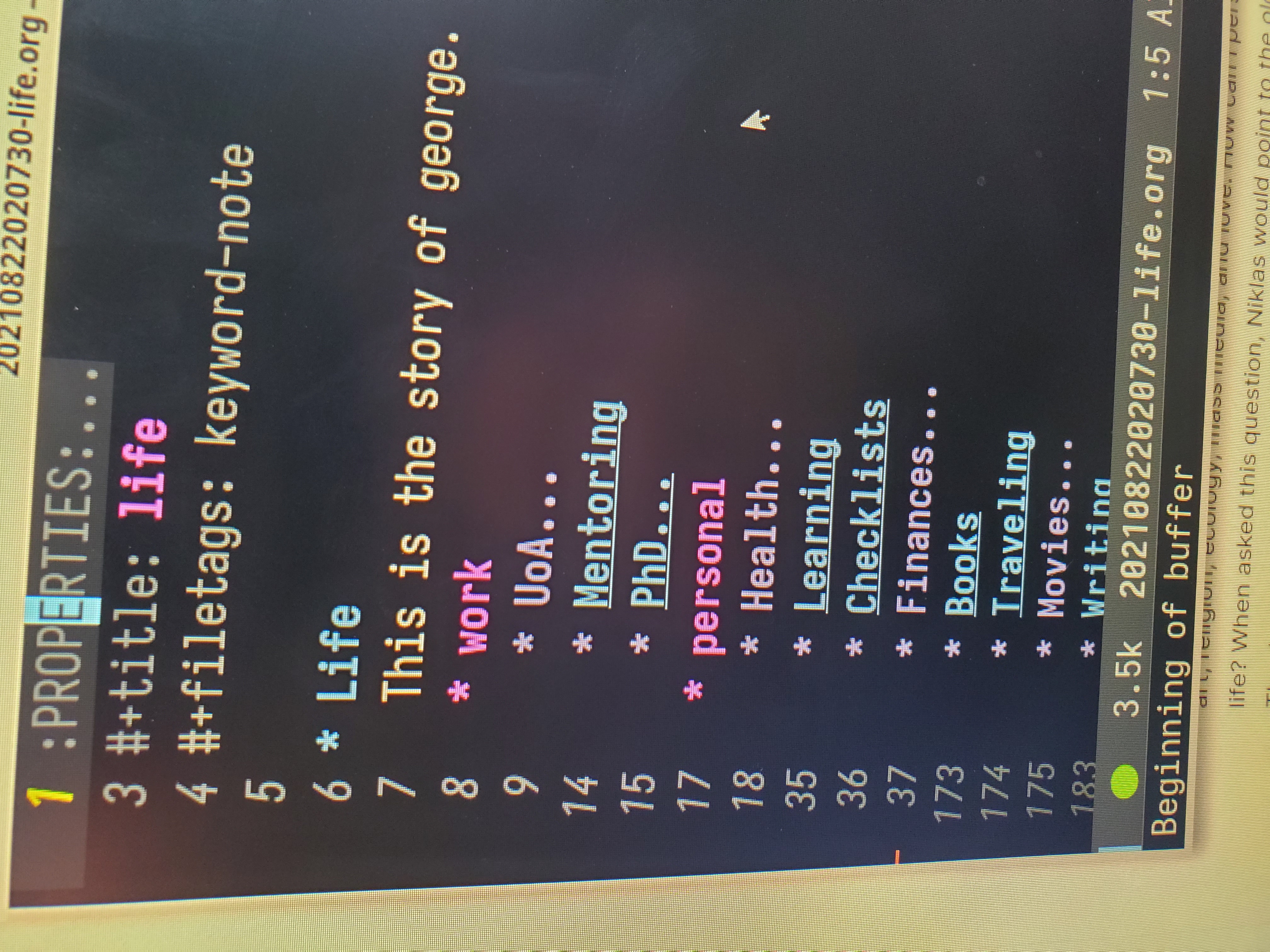
If you want my opinion, go with Obsidian. It is free for personal use. I use emacs and org-mode, but I am utterly insane… beyond insanity. So you don’t want to come down here.
This is emacs:
How can this help my science in practical terms?
Simply put, this will help you by preventing overload.
- Information Overload
- Choice Overload
- Collaborative Overload
- Technological Overload
Be a good scientist. Take notes. Make your work auditable and replicable at least a bit because the world is brutal, my fellow researcher. Scary place. Wonderful but scary.
Good luck!